Lostlingual
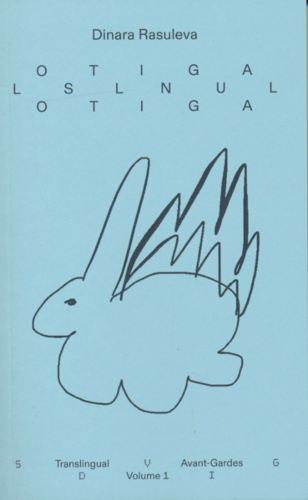
Rab-Rab Press, 125 blz., paperback, 2025, ISBN 9789526564654
Edited and translated + Afterword by Eugene Ostashevsky
Design by Bardhi Haliti
The first volume of sdvig: translingual avant-gardes are poems written by Berlin-based poet Dinara Rasuleva, written in her native Tatar language.
In Lostlingual, the Berlin-based poet Dinara Rasuleva returns to Tatar, the language of her childhood. She has used it only rarely as an adult, and never before as a creative writer - the national language of her people, smothered by Russian colonialism. She sets herself the goal of composing poetry in Tatar as she remembers it, without consulting dictionaries and grammars. The result is a collection of fragile and liberatory translingual poems, in which Tatar, English, German, and Russian call out, respond to, and transform one another. Rasuleva's language-mixing opens a new frontier in the poetics of decolonization.
Dinara Rasuleva (born 1987) is a Tatar poet and writer based in Berlin. She writes translingual poetry and prose in Russian, Tatar, English, and German. Since 2020, she has been running a fem-writing workshop-laboratory for immigrant women, Napishi, and since 2022, a workshop on writing in the native forgotten language, TEL:L.
Sdvig: translingual avant-gardes is edited by poet and translator Eugene Ostashevsky. Sdvig, a term used by the historical avant-garde in the late Russian Empire and the early Soviet Union to describe distortion and fracture of communication norms, derives from the verb sdvinut': to cause something to move, usually from one place to another. On the verbal plane, the most common variety of sdvig is the pun, which estranges language by foregrounding materiality, obfuscating reference, and multiplying meanings.
The series of translingual avant-garde writing is called sdvig, because translingualism, originating in the displacement of the body, ends up violating linguistic borders and adulterates "the language of the tribe", which poetry once set out to "purify". The series is also called sdvig, because, by questioning and estranging communication—especially interlingual and intercultural communication—translingualism at once illuminates and sabotages translation, ultimately turning it into a variety of wordplay.